
From Plastic Waste to High-Quality Recycled Granules: The Complete Manufacturing Process
Introduction
Plastic waste is often viewed as an environmental challenge, but when processed correctly it becomes a valuable industrial raw material. Modern recycling technologies allow used plastic to be transformed into high-quality recycled plastic granules that can be used in manufacturing a wide range of products.
Today, recycled granules are widely used by manufacturers because they help conserve natural resources, reduce landfill waste, and support sustainable production practices. As industries continue to adopt circular economy principles, the demand for quality recycled polymers continues to grow.
This guide explains how plastic waste is converted into recycled granules, the manufacturing process involved, quality control methods, and the industries that rely on these materials.
What Are Recycled Plastic Granules?
Recycled plastic granules, also known as recycled plastic pellets, are small uniform particles produced by processing waste plastic through cleaning, shredding, melting, filtration, and pelletizing.
These granules become the raw material for manufacturing numerous plastic products, reducing dependence on virgin plastic while giving discarded materials a second life.
Common Plastics Used for Granule Production
Several thermoplastics can be recycled into granules.
HDPE (High-Density Polyethylene)
HDPE is widely used for containers, drums, bottles, crates, industrial packaging, and piping. Its strength and durability make it one of the most commonly recycled plastics.
LDPE (Low-Density Polyethylene)
LDPE is commonly found in carry bags, agricultural films, packaging films, and flexible plastic sheets.
PP (Polypropylene)
Polypropylene is widely used in household products, furniture, automotive components, woven bags, and industrial packaging.
PET (Polyethylene Terephthalate)
PET is commonly recycled from beverage bottles and food containers and is often processed into flakes or polyester fibre.
PVC and Other Plastics
Certain plastics require specialized recycling methods because of their chemical composition and intended applications.
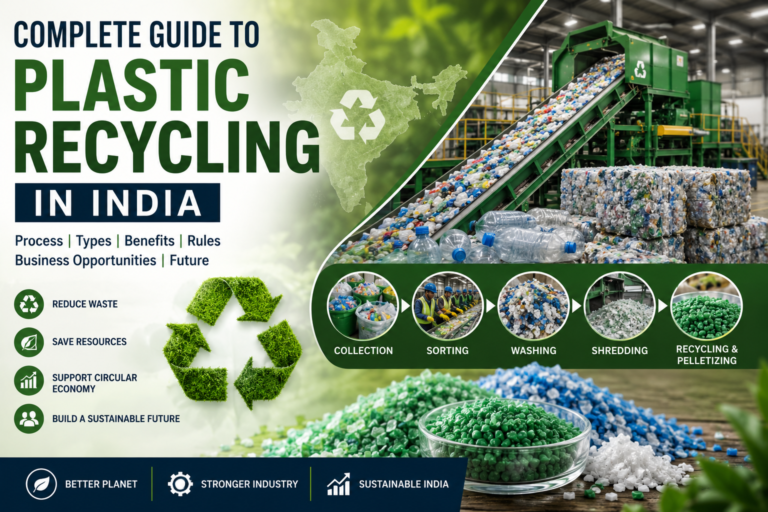
Step 1: Collection of Plastic Waste
The recycling journey begins with collecting plastic waste from various sources, including:
- Industrial manufacturing units
- Commercial establishments
- Packaging industries
- Municipal collection systems
- Recycling centers
Proper collection helps ensure a consistent supply of recyclable material.
Step 2: Sorting and Identification
Sorting is one of the most important stages of plastic recycling.
Plastic is separated according to:
- Polymer type
- Color
- Product application
- Contamination level
- Material quality
Accurate sorting improves recycling efficiency and produces more consistent granules.
Step 3: Washing and Cleaning
Collected plastic usually contains dust, labels, adhesives, oil, and other contaminants.
Industrial washing systems use multiple cleaning stages to remove impurities before processing.
Proper cleaning significantly improves the quality of the final recycled material.
Step 4: Shredding
Clean plastic is fed into shredders where it is reduced into small flakes.
Uniform flakes improve melting efficiency and ensure smooth feeding into extrusion equipment.
Step 5: Drying
Moisture removal is essential before extrusion.
Industrial drying systems reduce moisture content to help maintain product consistency and minimize processing defects.
Step 6: Extrusion
The plastic flakes enter an extruder where controlled heat melts the material.
Inside the extruder:
- Plastic softens gradually.
- The rotating screw mixes the material.
- Pressure builds uniformly.
- The molten plastic moves toward the filtration system.
Modern extrusion systems maintain consistent temperature and pressure to improve granule quality.
Step 7: Filtration
Before pelletizing, the molten plastic passes through filtration screens.
Filtration removes:
- Dust
- Paper particles
- Metal fragments
- Burnt material
- Other impurities
Effective filtration improves product consistency and surface finish.
Step 8: Pelletizing
After filtration, the molten plastic is converted into uniform granules.
Pelletizing produces:
- Consistent pellet size
- Better material flow
- Easier packaging
- Efficient storage
- Reliable processing by manufacturers
These granules are then cooled and prepared for packaging.
Quality Control in Recycled Granule Manufacturing
Maintaining quality is essential for industrial applications.
Manufacturers commonly evaluate:
- Uniform pellet size
- Consistent color
- Cleanliness
- Moisture level
- Melt Flow Index (MFI)
- Density
- Mechanical properties
- Process stability
Regular quality checks improve reliability and customer confidence.
Applications of Recycled Plastic Granules
Recycled granules are used across multiple industries.
Common applications include:
- Packaging products
- Household items
- Plastic containers
- Industrial components
- Automotive parts
- Agricultural products
- Construction materials
- Furniture
- Pipes and fittings
- Storage solutions
The suitability of recycled material depends on the polymer type and product requirements.
Environmental Benefits
Recycling plastic offers significant environmental advantages.
Reduces Plastic Waste
Recovering plastic from the waste stream helps divert material from landfills and unmanaged disposal.
Conserves Natural Resources
Using recycled polymers reduces the demand for new fossil-based raw materials.
Supports the Circular Economy
Plastic can be collected, processed, and reused in new products, extending the useful life of valuable materials.
Lowers Environmental Impact
Efficient recycling can reduce the overall environmental footprint associated with plastic production when compared with relying solely on virgin material.
Challenges in Plastic Recycling
The recycling industry also faces several practical challenges.
These include:
- Mixed plastic waste
- Poor segregation
- Contamination
- Inconsistent feedstock quality
- Collection inefficiencies
- Quality variation between batches
Continuous improvements in sorting technology, washing systems, and process control help address these issues.
Future of Recycled Plastic Granules
Advancements in recycling technology are improving the quality and consistency of recycled polymers.
Growing environmental awareness, increasing adoption of circular economy practices, and stronger recycling infrastructure are expected to support continued demand for high-quality recycled plastic granules across a wide range of industries.
Frequently Asked Questions
What are recycled plastic granules?
Recycled plastic granules are small pellets produced by processing cleaned and sorted plastic waste into reusable raw material for manufacturing.
Which plastics can be converted into granules?
Common recyclable plastics include HDPE, LDPE, PP, and PET, though suitability depends on the material and intended application.
Why is washing important before recycling?
Cleaning removes contaminants that can affect processing efficiency and the quality of the finished granules.
What industries use recycled plastic granules?
Packaging, automotive, agriculture, construction, furniture, consumer goods, and many other industries use recycled granules in suitable applications.
Are recycled granules environmentally beneficial?
When produced through well-managed recycling processes, recycled granules help recover valuable materials, reduce waste, and support more sustainable manufacturing.
Conclusion
Recycled plastic granules demonstrate how discarded plastic can be transformed into a valuable industrial resource. Through systematic collection, sorting, cleaning, extrusion, filtration, and quality control, waste plastic can be processed into reliable raw materials used in countless manufacturing applications.
As recycling technologies continue to advance and industries embrace circular economy principles, high-quality recycled granules will play an increasingly important role in conserving resources and supporting responsible production.